How Executive Transitions Are Governed
This is not a product overview. This is a system walkthrough showing exactly how AI-native outplacement works — with defined inputs, weekly accountability checkpoints, and documented exit conditions.
Every executive engagement runs through this operating system. Constraints are diagnosed. Tools are aligned. Stalls are detected early. Exits are documented.
The EMOS System Map
Six interconnected nodes govern every executive transition. Each node has defined inputs, outputs, and HR visibility rules.
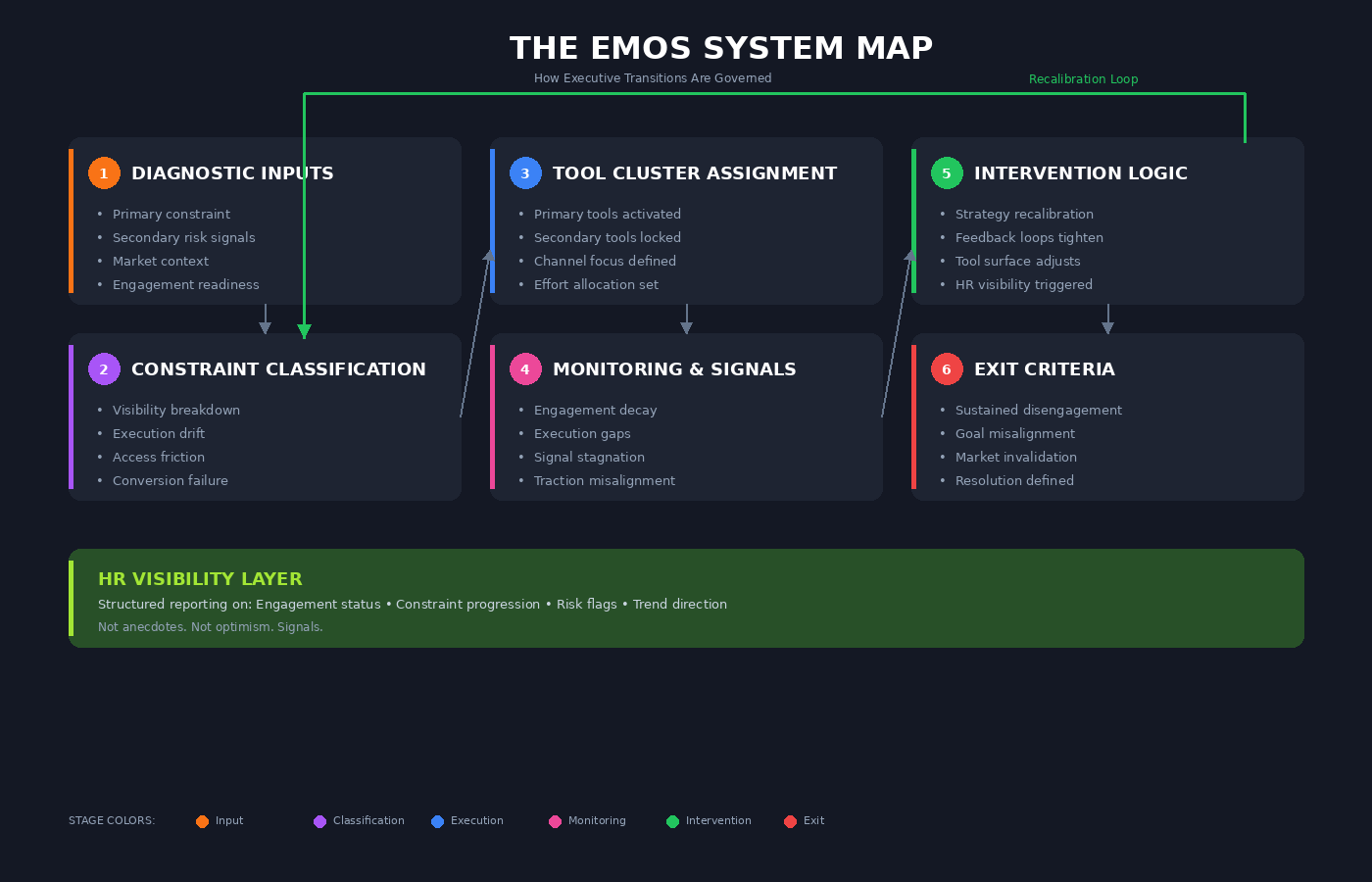
Complete system architecture showing governance flow from intake to exit
System Components
Diagnostic Inputs
What enters the system:
What HR sees:
At intake: Constraint classification and readiness status. Nothing else until system progression.
Constraint Classification
The four constraint types determine tool cluster assignment:
Prevents tool overwhelm and misallocated effort.
Monitoring & Indicators
System tracks:
Detection timing:
Checked weekly. Flagged within 7 days of threshold breach. Not discovered at month six.
Intervention Logic
When the system detects stall conditions:
Governed intervention based on progress indicators. Not guesswork.
Exit Criteria
The system stops when defined conditions are met:
Sustained Disengagement
Activity below threshold for 3+ weeks despite intervention
Goal Misalignment
Executive objectives no longer match system scope
Market Invalidation
Role demand does not exist at target level
Resolution
Placement achieved or executive exits voluntarily
Exit criteria protect the organization from prolonged uncertainty and protect the executive from misaligned effort.
What EMOS Governs — And What It Does Not
EMOS Governs:
HR Can See:
Engagement status, constraint classification, trend direction, risk flags, and exit reason.
EMOS Does Not Control:
HR Cannot Force:
Tool usage, outreach volume, interview scheduling, or executive behavior.
The system governs conditions. It does not guarantee outcomes. This boundary is the source of defensibility.
What Happens When Momentum Stalls
Most vendors hide failure. EMOS surfaces it early. This is a feature, not a bug.
Structured progression
System detects engagement decay within 7 days. Flags raised before HR asks. Pattern recognition, not guesswork.
Re-Diagnosis
Constraint may have shifted. New classification triggers new tool cluster. Prior effort informed the shift—not wasted.
Intervention
Cadence adjusts. Feedback loops tighten. HR visibility increases. All governed by progress indicators.
Exit (When Appropriate)
Sustained disengagement. Market invalidation. Goal mismatch. Documented exit with audit trail.
Why this matters to HR: When you select a system that surfaces failure early, you are protected from the alternative—discovering at month six that nothing worked, with no audit trail explaining why.
See the System in Action
Concrete artifacts from the governance system. These are what HR leaders and outplacement providers receive for each executive in the structured engagement.
Weekly Progress Report
Weekly visibility into constraint resolution, engagement quality, and momentum metrics. Structured reporting for HR sponsors without micromanagement.
- 4C constraint scores over time
- Tool engagement metrics
- Progress indicators: recruiter replies, warm introductions, and stage progression
Engagement Cadence
Structured touchpoints that maintain accountability without requiring constant oversight. Defined weekly rhythm with clear expectations.
- Weekly checkpoint schedule
- Milestone definitions
- Escalation protocols
Intervention Trigger
Automated escalation when metrics indicate stalled momentum. System identifies constraint and surfaces recommended intervention.
- Progress criteria
- Recommended next actions
- HR sponsor notification
Screenshots represent sample outputs. Actual reports customized to your organization's requirements.
If This Matches Your Requirements
If a transition stalls and you are asked what the organization did about it, this system is the answer. Defined inputs at entry. Weekly checkpoints during. Documented criteria at exit. Not a coaching relationship. A governed operating system with a record.
Organizations that require placement guarantees or primarily advisor-led models typically need a different solution.
If you need AI-native outplacement with visible weekly controls, structured progression, and documented exit conditions, we can assess fit in one conversation.
No scheduling pressure. No sales sequence. One conversation to assess organizational fit.